Communication Starts Before a Child Says a Word
Picture two students answering the same question in class. One says, “Yes, sir,” with a clear voice, standing tall, eyes up. The other mumbles the same two words at the floor. Same words — completely different message.
If you're a parent considering martial arts for your child, you're probably thinking about more than kicks and punches. Will this help my child listen? Will it help them speak up? Will they carry themselves with more confidence at school, at home, and around other people?
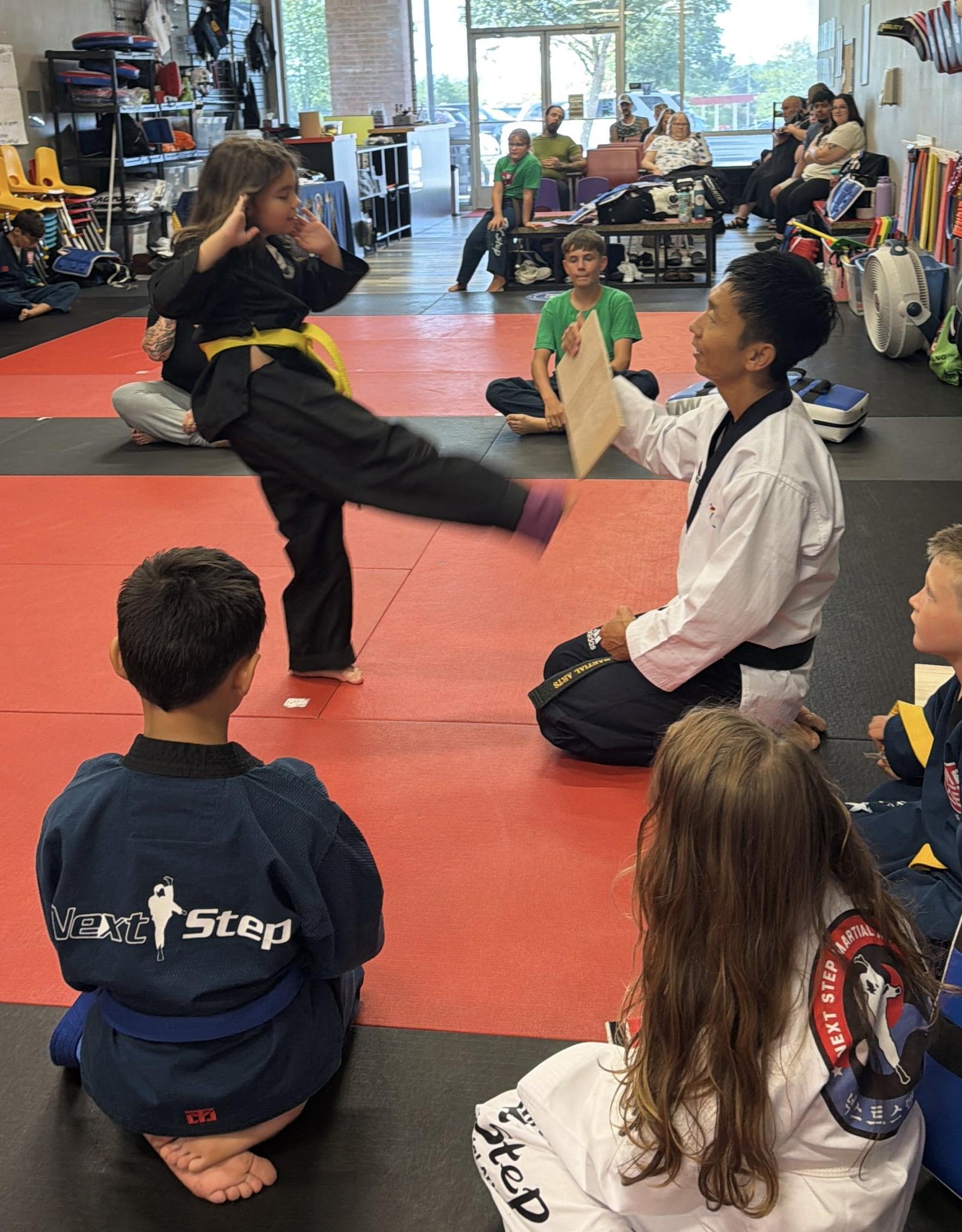
Those are the right questions. At NEXTStep Martial Arts, Taekwondo is a tool for teaching life skills — the movements matter, but the lesson is bigger than the movement. And one of the biggest lessons is this: a child is communicating all the time, through posture, eye contact, voice, and listening, often without saying much at all.
What Does Your Child's Body Language Say?
In the dojang, we teach children to stand tall, make eye contact, and speak clearly. Not to act like someone they're not — to be present.
A child who looks away, turns their body, or speaks too quietly to be understood may be communicating uncertainty even when they know the answer. A shrug, a nervous sound, a lowered head, a stiff posture — each one tells us something about confidence, worry, hesitation, or frustration. The body is always saying something.
That's why our classes are about more than memorizing techniques. We watch how students enter the room, how they respond to instruction, how they listen to a partner, and how they recover when something feels difficult. When a child stands with control and speaks so others can hear, people experience them differently.
Confidence Is Practiced, Not Announced
Most children don't become confident because an adult tells them, “Be confident.” That rarely works for long. Confidence grows when a child practices a behavior, gets guidance, and discovers, “I can do this.”
What that practice looks like depends on age. In Tiny Tigers, children ages 4-6 may practice standing still, answering with a clear voice, and following one direction at a time. In Junior Warriors, ages 7-12, students begin handling more complicated combinations, partner work, and responsibility. In Teen & Adult classes, students continue developing control, communication, and focus in a different stage of life.
The age changes; the lesson doesn't. Your child does not need to feel confident before they practice confident behavior. They can stand tall first. Make eye contact first. Speak clearly first. The feeling catches up.
Then something shifts. They notice that other people listen when they speak. They notice they can ask a question, or say, “I need help,” instead of shutting down. That is real progress.
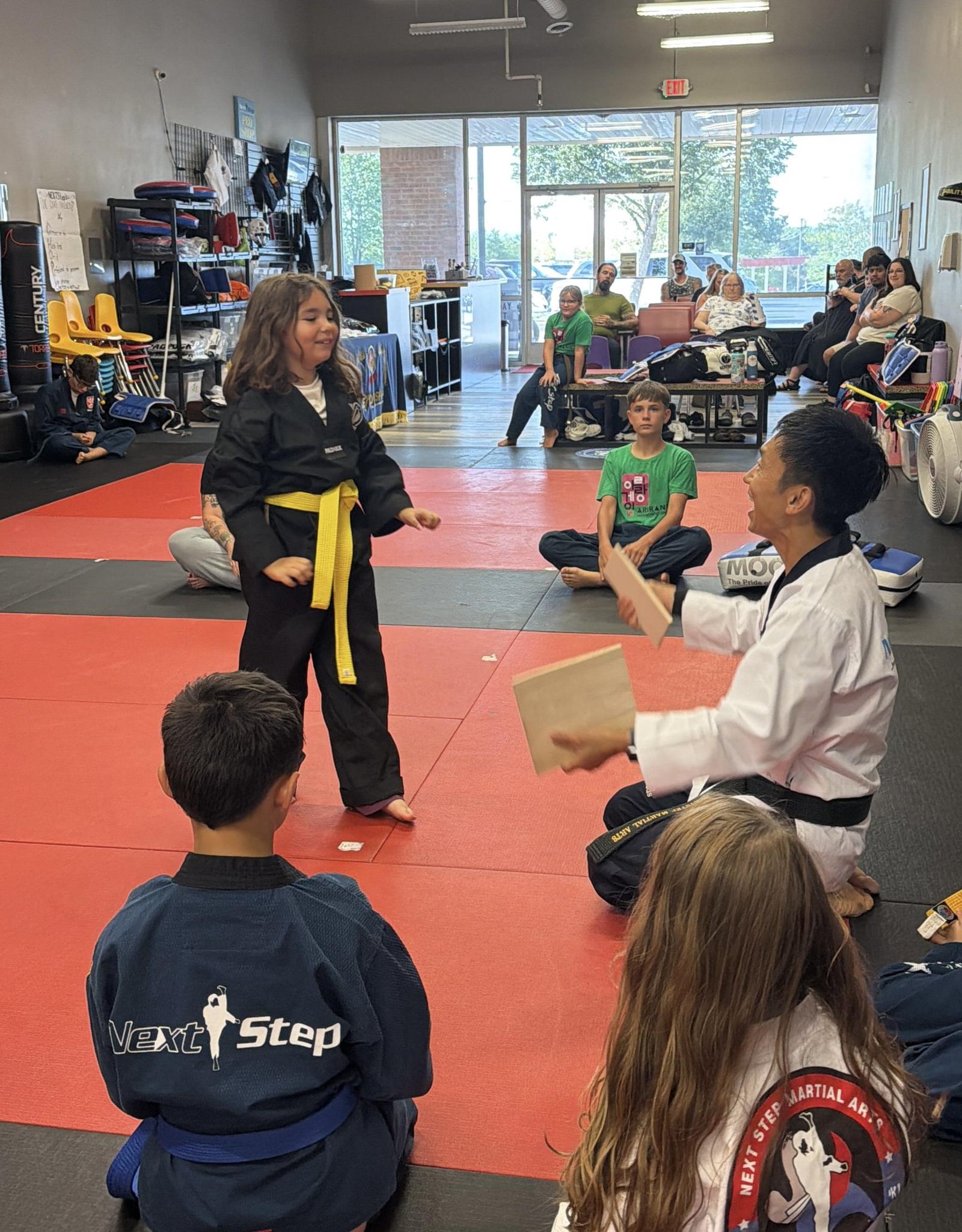
Questions Can Put Responsibility Back in Their Hands
Most of us have asked a child an accusing question without meaning to. “Why are you acting like that?” “What is wrong with you?” A child usually hears those as an attack — so they defend themselves instead of thinking about what happened.
A reflective question opens a different door. “What were you trying to do?” “How do you think that sounded to the other person?” “What could you try next time?” You're not accusing. You're putting the emphasis where it belongs: back in their hands.
Children often have more of the answer than we think. They may know they interrupted, or used a sharp voice, or stopped listening because they got frustrated. A good question gives them room to recognize it and choose a better response.
We teach the same way at NEXTStep. Instead of only saying, “That was wrong,” we want students to understand what happened. What did your posture say? Did your voice match your message? Were you listening? How can you repair the situation?
Control Your Body, Control Your Message
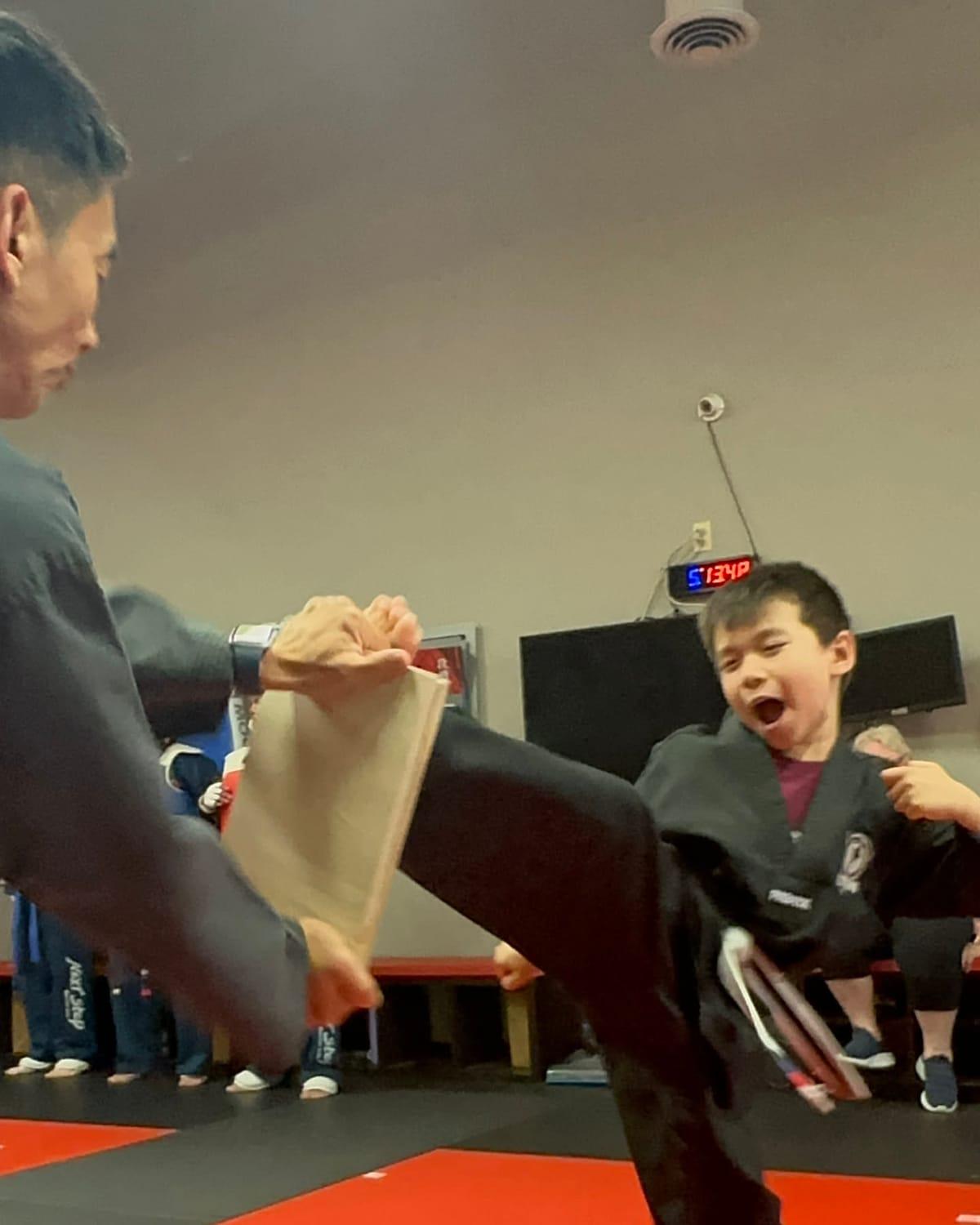
Martial arts gives children a very concrete lesson in responsibility: if you don't control your body, you could hurt yourself or someone else, even when you didn't intend to. A careless kick can hit a partner. A hand can move too quickly. So in Taekwondo, we teach control — because power without control is not a finished skill.
The same principle applies to words. Words can hurt, even when the speaker says, “I was only joking.” Intention matters, but impact matters too. If someone is hurt, the next step is not to argue about whether the harm was intended. The next step may be to stop, listen, and apologize.
And when a student makes an honest mistake, there is no reason for embarrassment. Mistakes are part of learning. What should concern us is refusing to try when we know we can make an effort.
Learning to Apologize and Move Forward
Apologizing is hard — for children and for adults. We're embarrassed. We think the other person misunderstood us. We want to prove we were right before we say anything kind. But waiting usually makes the roadblock bigger.
Here is a lesson worth passing on: if you decide to apologize, do it sooner rather than later, and do it sincerely. You don't have to win the argument before you repair the relationship. You can say, “I am sorry I spoke that way,” or, “I am sorry my body was not under control.” Then you can move forward.
This doesn't mean children should accept blame for everything. It means they can take responsibility for their part — and that is a strong kind of confidence. A child who can say, “I made a mistake,” is not weak. That child is learning control.
Supporting Your Child at Home
You can reinforce all of this without turning home into another class. When your child speaks, pause and give them your attention. Notice when they make eye contact or listen carefully. And keep a few small moves in your back pocket:
- Ask, “What message did your body send?”
- Say, “Try that again with a clear voice.”
- Ask, “What happened from the other person's point of view?”
- Encourage a sincere apology when your child's actions or words cause harm.
- Praise honest effort, especially when your child makes a mistake and keeps trying.
Keep it simple. Children don't need a long speech every time — one question, one correction, and one chance to try again is often enough.
That's what Taekwondo gives us: a way to practice these skills again and again. Stand tall. Listen. Speak clearly. Control your body. Take responsibility. Try again. If that's the kind of confidence you'd like to see in your child, it's exactly what we work on at NEXTStep, class after class.
See It In Action
Everything we write about, we practice daily. Come see the difference in person with a free intro class.
Schedule Your Free Intro ClassNo obligation, just opportunity
